
Description
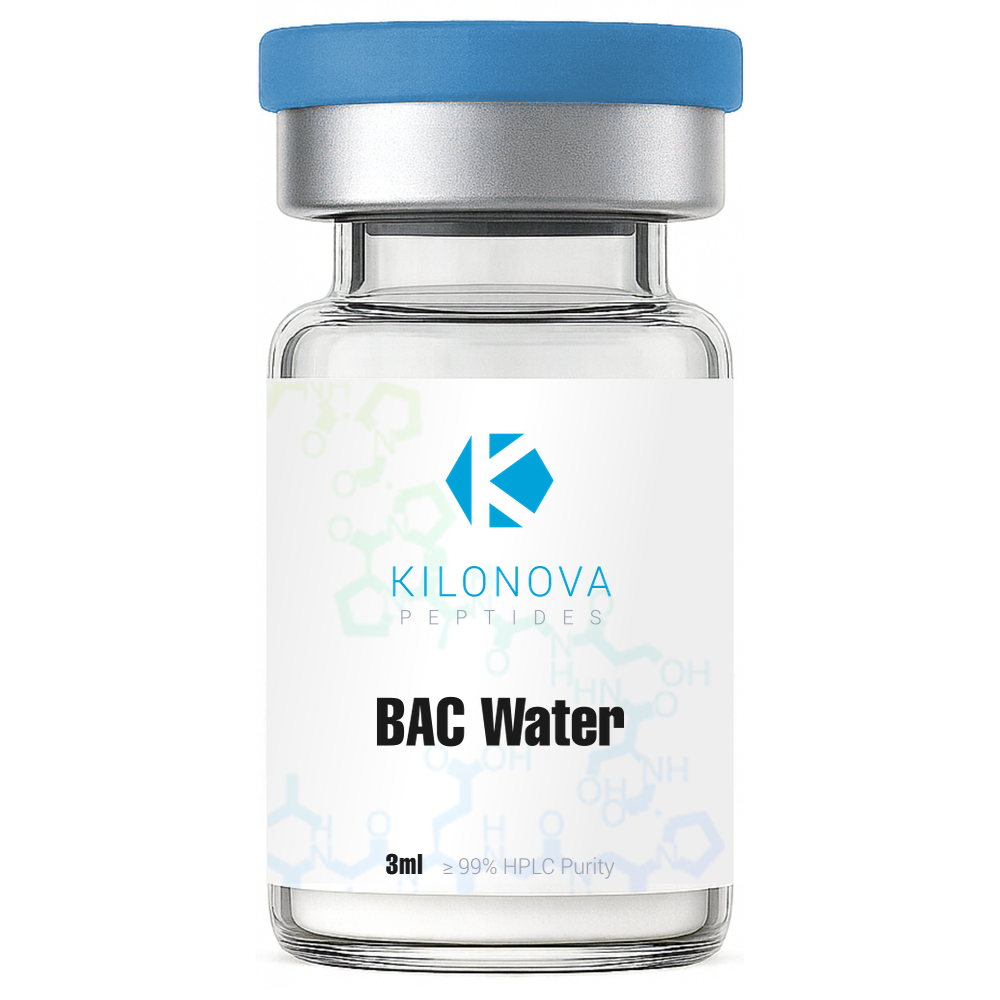
Bacteriostatic water is a sterile aqueous preparation containing 0.9% benzyl alcohol as a preservative. The benzyl alcohol component distinguishes it from plain sterile water for injection by inhibiting the proliferation of microorganisms within the vial, allowing the solution to be re-entered multiple times without compromising the integrity of the remaining contents. Water itself is registered as a small molecule compound (molecular weight 18.02) within compound databases such as ChEMBL [5].
The 0.9% benzyl alcohol concentration is a well-characterized preservative standard used across a range of laboratory reconstitution workflows. Published in vitro work has demonstrated that reconstitution with bacteriostatic water (0.9% benzyl alcohol) can maintain protein monomer integrity and meet USP criteria for microbial growth inhibition over extended incubation periods [3]. These properties make it a practical diluent choice when repeated sampling from a single vial is required during experimental protocols.
Researchers routinely use bacteriostatic water when reconstituting lyophilized peptides and sensitive biologics for in vitro and preclinical study. Its utility has been documented across diverse research contexts, including the reconstitution of lipopeptide antibacterial agents [1] and biotechnology-derived growth factors where minimizing sample waste during preparation is a methodological priority [2]. Its predictable dilution behavior and antimicrobial characteristics support reproducibility across multi-day or multi-dose experimental timelines.
---
References
[1] Daptomycin: a comparison of two intravenous formulations. Drug Design, Development and Therapy, 2018. https://pubmed.ncbi.nlm.nih.gov/29988771/
[2] Getting the most out of low-dose syringe prefilling of a high-cost biotechnology agent. Hospital Pharmacy, 1994. https://pubmed.ncbi.nlm.nih.gov/10133464/
[3] In vitro stability and compatibility of tenecteplase in central venous access devices. Hemodialysis International, 2011. https://pubmed.ncbi.nlm.nih.gov/21414130/
[5] WATER (ChEMBL CHEMBL1098659). ChEMBL, European Bioinformatics Institute. https://www.ebi.ac.uk/chembl/compound_report_card/CHEMBL1098659/