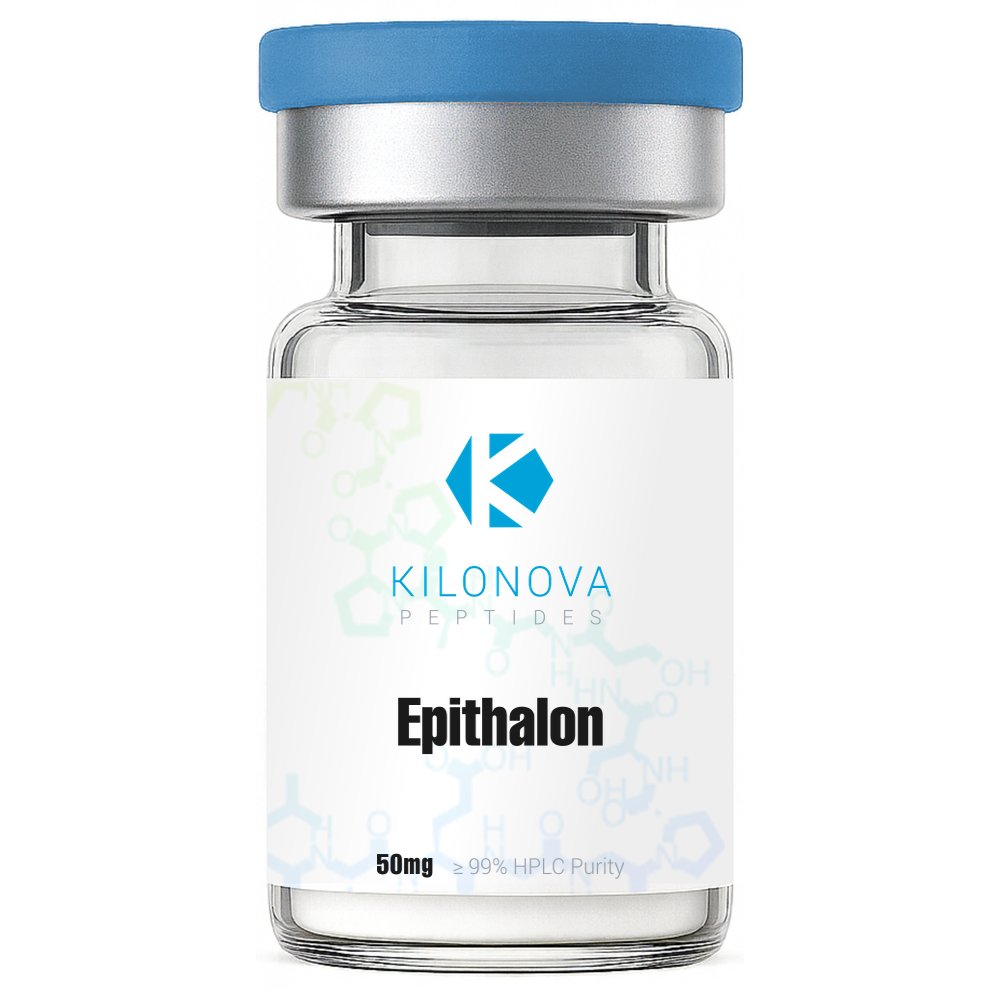
Description
Epithalon (also rendered as Epitalon or Epithalone) is a synthetic tetrapeptide composed of the amino acid sequence Ala-Glu-Asp-Gly (AEDG) [2]. Its sequence was derived from the amino acid composition of Epithalamin, a polypeptide extract isolated from bovine pineal gland tissue, prior to the identification of Epithalamin's active components [5]. As a short-chain peptide of defined primary structure, Epithalon occupies a well-characterized position in peptide biochemistry research and has accumulated a substantial body of preclinical literature spanning in vitro, in vivo, and in silico experimental approaches [2].
Laboratory investigators primarily employ Epithalon to probe telomere biology and telomerase regulation. Work conducted in human fetal fibroblast cultures demonstrated that exposure to the peptide induced expression of telomerase's catalytic subunit, elevated enzymatic telomerase activity, and produced measurable telomere elongation in cells that were otherwise telomerase-negative [4]. These observations have positioned the compound as a useful molecular tool for exploring the mechanisms by which somatic cell populations maintain or lose replicative capacity over successive divisions.
Beyond telomere dynamics, Epithalon has been investigated in the context of neuroendocrine signaling and circadian biology, with studies documenting effects on melatonin synthesis, interleukin-2 mRNA levels, murine thymocyte mitogenic activity, and the activity of enzymes including acetylcholinesterase and butyrylcholinesterase [2]. Researchers in the aging biology field have also noted geroprotective properties attributed to antioxidant, neuroprotective, and antimutagenic mechanisms, both specific and nonspecific in character [2]. A review of orthopaedic peptide research further categorizes Epithalon among agents that target circadian and mitochondrial regulatory pathways in preclinical models [1].
Preclinical in vivo work has extended the compound's research scope to oncology-adjacent questions; studies in transgenic HER-2/neu mice examined its influence on reproductive aging markers and spontaneous tumor development under controlled experimental conditions [3]. Across these varied research contexts, Epithalon serves as a chemically defined probe for investigating peptide-mediated modulation of cellular aging pathways and molecular signaling networks.
---
References
[1] Therapeutic Peptides in Orthopaedics: Applications, Challenges, and Future Directions. Journal of the American Academy of Orthopaedic Surgeons. Global research & reviews, 2026. https://pubmed.ncbi.nlm.nih.gov/41490200/
[2] Overview of Epitalon-Highly Bioactive Pineal Tetrapeptide with Promising Properties. International journal of molecular sciences, 2025. https://pubmed.ncbi.nlm.nih.gov/40141333/
[3] Epithalon decelerates aging and suppresses development of breast adenocarcinomas in transgenic her-2/neu mice. Bulletin of experimental biology and medicine, 2002. https://pubmed.ncbi.nlm.nih.gov/12459848/
[4] Epithalon peptide induces telomerase activity and telomere elongation in human somatic cells. Bulletin of experimental biology and medicine, 2003. https://pubmed.ncbi.nlm.nih.gov/12937682/
[5] Epitalon. Wikipedia. https://en.wikipedia.org/wiki/Epitalon