Description
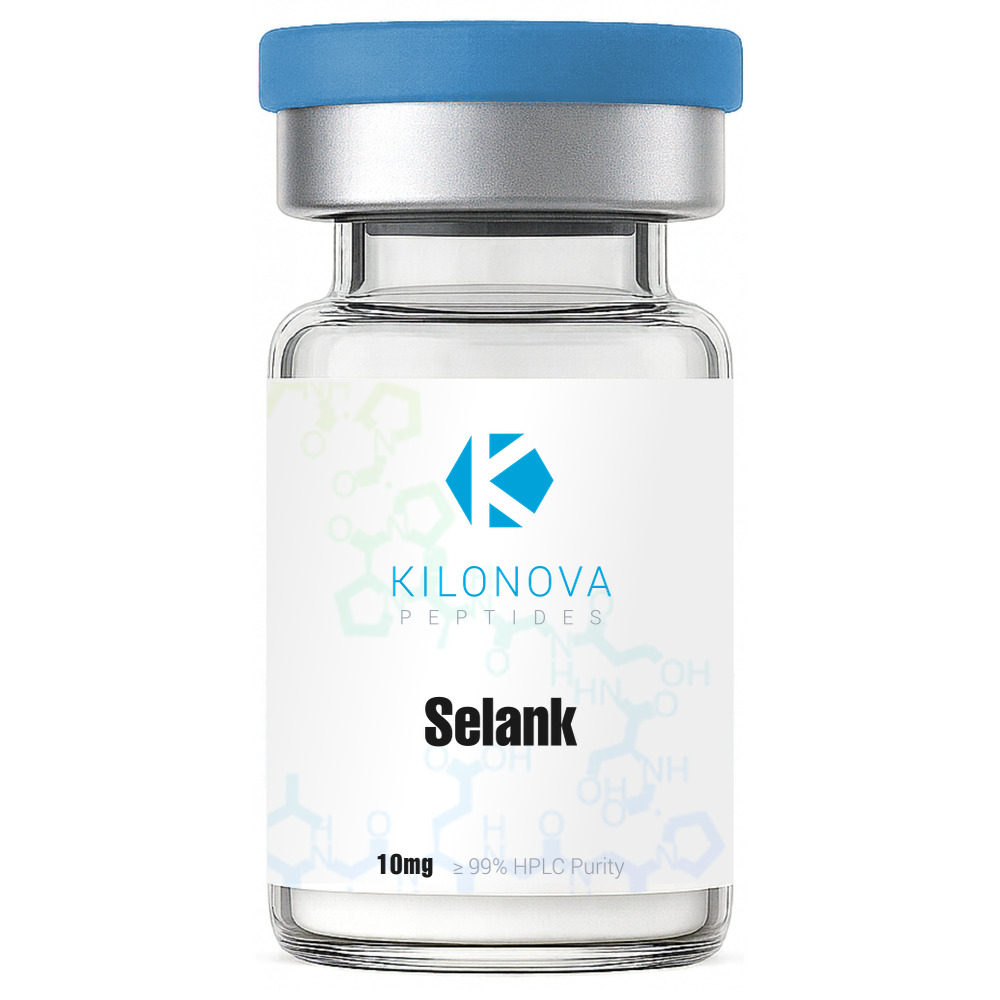
Selank is a synthetic heptapeptide of the sequence Thr-Lys-Pro-Arg-Pro-Gly-Pro (TKPRPGP), developed originally by the Institute of Molecular Genetics of the Russian Academy of Sciences [7]. It belongs to the class of tuftsin analog peptides, sharing structural lineage with the endogenous immunomodulatory tetrapeptide tuftsin (TKPA), while incorporating additional residues that confer distinct pharmacological properties in experimental models [3][7].
From a structural standpoint, Selank is a relatively low-molecular-weight peptide registered in compound databases with a molecular weight of approximately 521 Da [5]. Its proline-rich C-terminal extension distinguishes it from the native tuftsin scaffold, and this modification is understood to influence its interactions with receptor systems and signaling pathways relevant to neuroactive peptide research [7].
Researchers have drawn on Selank to investigate neuromodulatory signaling, including its reported association with brain-derived neurotrophic factor (BDNF) and HGF/c-Met pathways implicated in neuroplasticity studies [1]. Additional preclinical work has examined its involvement in anxiety-related behavioral models and functional brain connectivity, with imaging studies characterizing its effects on resting-state connectivity between the amygdala and temporal cortical regions [2]. These properties make it a subject of interest for researchers studying anxiolytic mechanisms, immunomodulation, and peptide-receptor dynamics in controlled experimental settings.
References
[1] Therapeutic Peptides in Orthopaedics: Applications, Challenges, and Future Directions. Journal of the American Academy of Orthopaedic Surgeons. Global research & reviews, 2026. https://pubmed.ncbi.nlm.nih.gov/41490200/
[2] Functional Connectomic Approach to Studying Selank and Semax Effects. Doklady biological sciences : proceedings of the Academy of Sciences of the USSR, Biological sciences sections, 2020. https://pubmed.ncbi.nlm.nih.gov/32342318/
[3] Tuftsin - Properties and Analogs. Current medicinal chemistry, 2017. https://pubmed.ncbi.nlm.nih.gov/28745220/
[5] TP-020n (ChEMBL CHEMBL4585920). ChEMBL, European Bioinformatics Institute. https://www.ebi.ac.uk/chembl/compound_report_card/CHEMBL4585920/
[7] Selank. Wikipedia. https://en.wikipedia.org/wiki/Selank