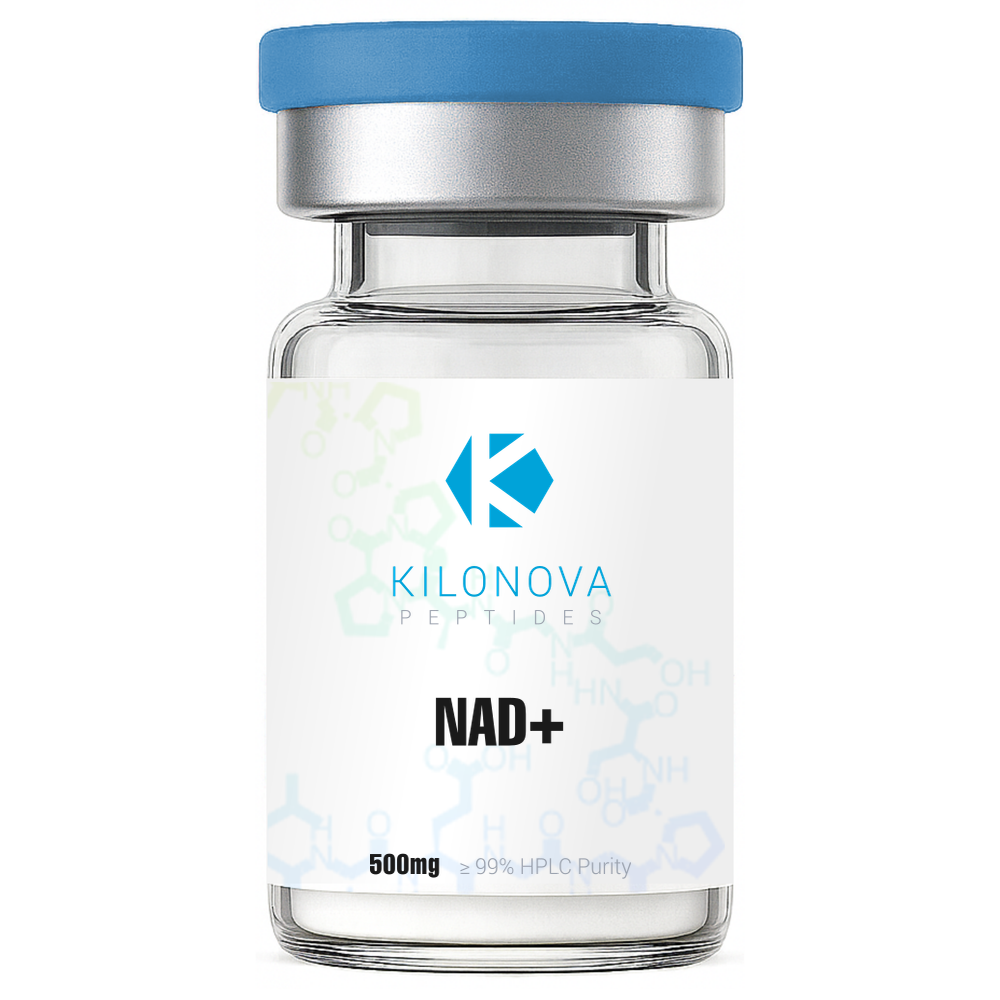
Description
Nicotinamide adenine dinucleotide (NAD+) is a coenzyme found universally across living cells and belongs to the dinucleotide chemical class [5]. Its structure comprises two nucleotides — one built on an adenine nucleobase, the other on nicotinamide — linked through their respective phosphate groups [5]. The compound cycles between its oxidized form (NAD+) and its reduced counterpart (NADH), a reversible interconversion that sits at the mechanistic core of cellular redox chemistry [5].
Researchers rely on NAD+ as a biochemical tool for investigating metabolic signaling, mitochondrial function, and coenzyme-dependent enzyme activity. It serves as an obligate substrate for the sirtuin family of regulatory proteins; for example, Sirt5 has been characterized as an NAD+-dependent lysine desuccinylase and demalonylase, with its acyl-pocket residues conferring selectivity for succinyl and malonyl modifications on target proteins [1]. These findings position NAD+ as an indispensable reagent in studies of post-translational modification and protein regulation.
Beyond sirtuin biology, NAD+ occupies a central role in research on compartmentalized reductive metabolism. Mitochondrial NAD(H) pools serve as the phosphorylation substrate for NAD kinase 2, which generates the NADP(H) required to sustain proline biosynthesis and support cytosolic protein production in cell-based models [2]. Separately, the NADPH pool derived from the pentose phosphate pathway has been studied in immune-cell contexts, where modulating flux through that pathway alters NADPH oxidase-dependent oxidative outputs in neutrophil assays [3]. Plant innate immunity research has further extended NAD+ biology, demonstrating that certain nucleotide-binding immune receptors acquire NADase enzymatic activity upon pathogen-effector-driven tetramerization [4].
Research-grade NAD+ materials are characterized by defined purity and endotoxin-testing profiles, properties considered essential for minimizing assay interference in sensitive biochemical and cell-based experiments.
---
References
[1] Sirt5 is a NAD-dependent protein lysine demalonylase and desuccinylase. Science (New York, N.Y.), 2011. https://pubmed.ncbi.nlm.nih.gov/22076378/
[2] Mitochondrial NADP(H) generation is essential for proline biosynthesis. Science (New York, N.Y.), 2021. https://pubmed.ncbi.nlm.nih.gov/33888598/
[3] Selective activation of PFKL suppresses the phagocytic oxidative burst. Cell, 2021. https://pubmed.ncbi.nlm.nih.gov/34320407/
[4] Direct pathogen-induced assembly of an NLR immune receptor complex to form a holoenzyme. Science (New York, N.Y.), 2020. https://pubmed.ncbi.nlm.nih.gov/33273071/
[5] Nicotinamide adenine dinucleotide. Wikipedia. https://en.wikipedia.org/wiki/Nicotinamide_adenine_dinucleotide