Description
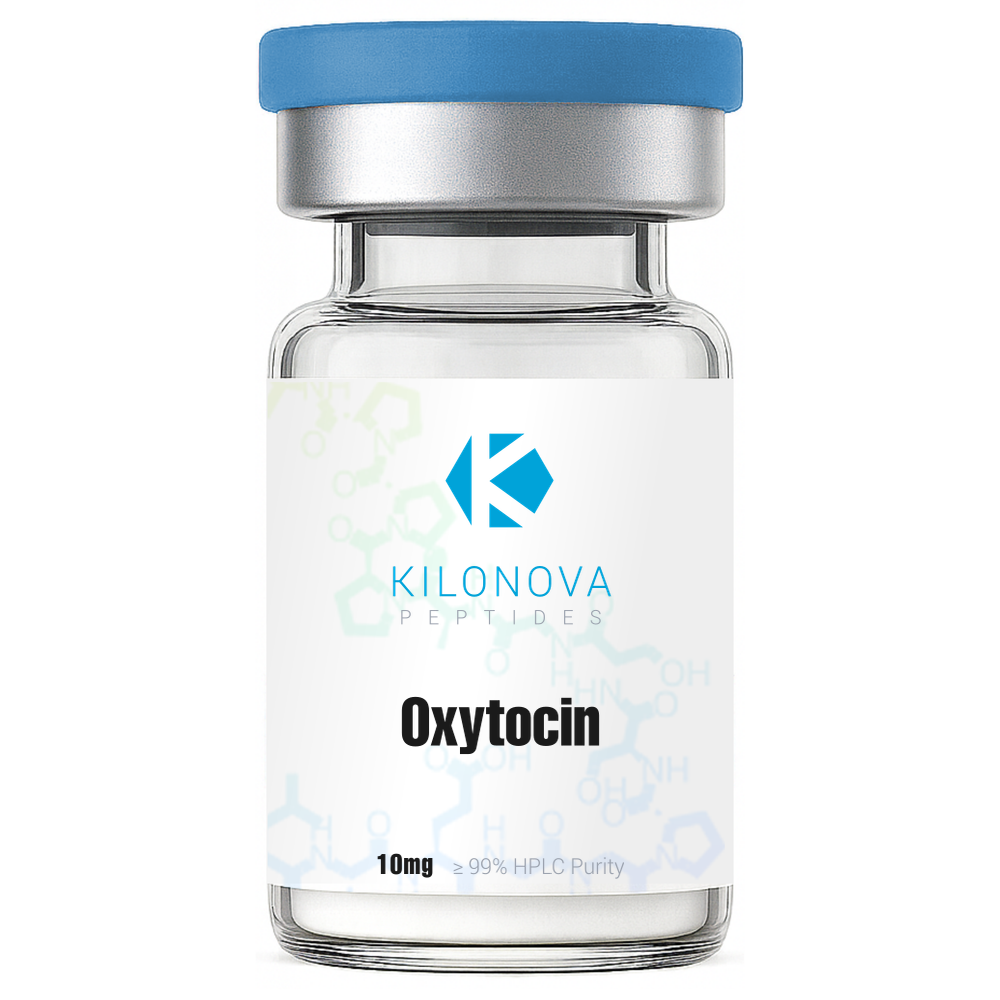
Oxytocin is a cyclic nonapeptide hormone and neuropeptide biosynthesized in the hypothalamus and released peripherally via the posterior pituitary [5]. Its primary structure, elucidated in 1953, features a six-residue disulfide-bridged ring and a three-residue C-terminal tail — an architecture that has made it one of the most extensively characterized cyclic peptides in biochemical research [4]. The molecule interacts with a dedicated G protein-coupled receptor, the oxytocin receptor (OTR), through binding interactions that researchers evaluate using classical receptor-occupancy and Scatchard analysis frameworks [3].
In the central nervous system, oxytocin functions as a neuropeptide modulator of social behavior circuitry. Preclinical investigations have linked oxytocin signaling to maternal nurturing, social reward, pair bonding, and the salience of social stimuli, positioning it as a key research subject for understanding how neuropeptide circuits shape behavior across species [1]. Researchers also examine the peptide's role within hypothalamic regulatory networks; studies of Prader-Willi syndrome, for example, have used oxytocin system dysregulation as a model for probing broader hypothalamic dysfunction [2].
The compound's relatively compact, well-defined structure has driven decades of analog design work. Thousands of agonist and antagonist derivatives have been synthesized and evaluated in experimental settings, making native oxytocin a standard reference ligand for receptor-binding assays, selectivity profiling against related receptors such as the vasopressin V1a receptor, and mechanistic studies of neuropeptide pharmacology [4]. Research-grade oxytocin is routinely employed in cellular assays, molecular signaling studies, and controlled in vitro experimental models where reproducibility and endotoxin-free formulation are priorities.
---
References
[1] Oxytocin, Vasopressin, and Social Behavior: From Neural Circuits to Clinical Opportunities. Endocrinology, 2022. https://pubmed.ncbi.nlm.nih.gov/35863332/
[2] Endocrine disorders in Prader-Willi syndrome: a model to understand and treat hypothalamic dysfunction. The Lancet. Diabetes & Endocrinology, 2021. https://pubmed.ncbi.nlm.nih.gov/33647242/
[3] Hormone receptors. The New England Journal of Medicine, 1979. https://pubmed.ncbi.nlm.nih.gov/226885/
[4] Design of Oxytocin Analogs. Methods in Molecular Biology, 2019. https://pubmed.ncbi.nlm.nih.gov/31134574/
[5] Oxytocin. Wikipedia. https://en.wikipedia.org/wiki/Oxytocin