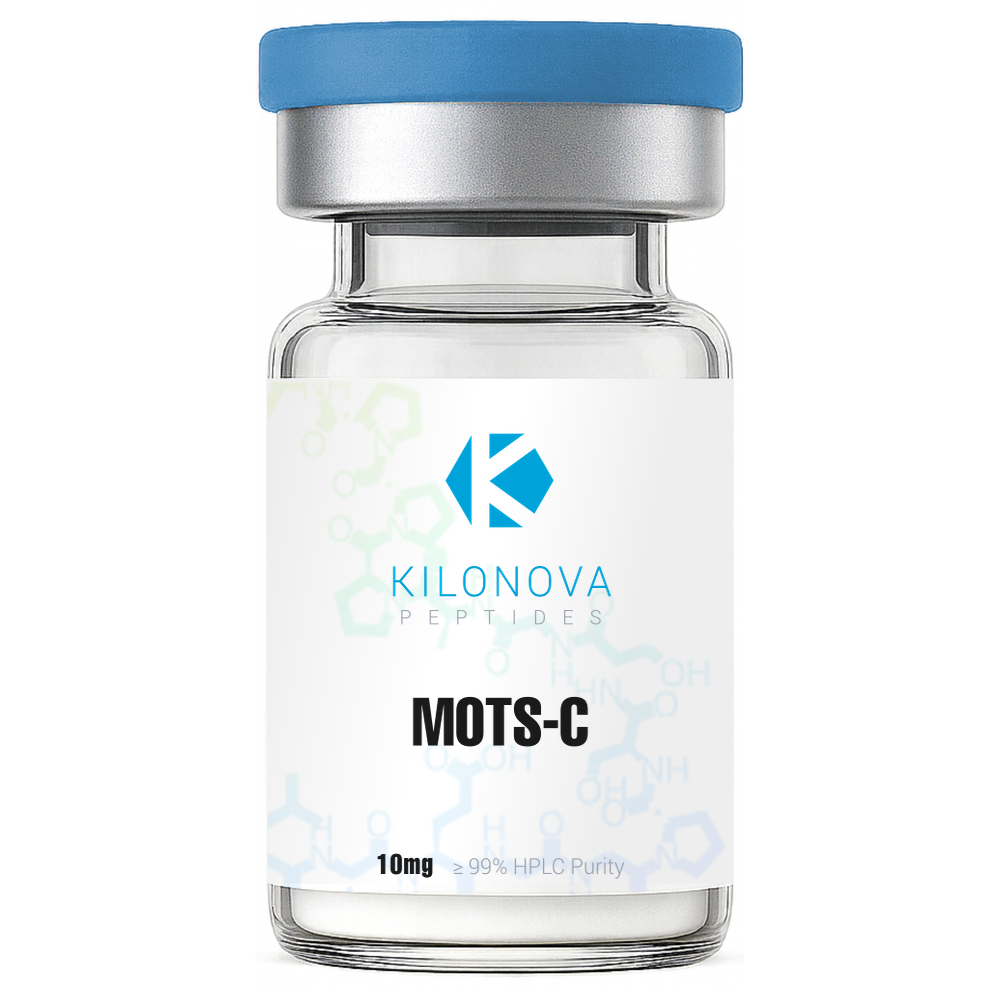
Description
MOTS-c (Mitochondrial Open Reading Frame of the 12S rRNA-c) is a 16-amino-acid peptide encoded by a short open reading frame within the mitochondrial 12S rRNA gene — specifically the MT-RNR1 locus — giving it the unusual distinction of being a signaling peptide derived from the mitochondrial genome rather than the nuclear genome [1][5]. Its primary sequence, MRWQEMGYIFYPRKLR, is conserved in humans, and the peptide is detected not only within cells but also in circulation, where its levels have been observed to decline with age [2].
What sets MOTS-c apart structurally and functionally is its capacity to operate across compartments. Under basal conditions the peptide is associated with mitochondria, yet during episodes of metabolic stress it has been shown to translocate to the nucleus, where it participates in regulating nuclear gene expression [1][2]. This retrograde signaling axis positions MOTS-c as a key subject in research examining how mitochondria communicate with other cellular compartments to coordinate adaptive responses [4].
A principal focus of MOTS-c research has been its influence on metabolic pathways in skeletal muscle. Preclinical work demonstrated that the peptide acts on the folate cycle and linked de novo purine biosynthesis, leading to AMPK activation and downstream effects on insulin sensitivity and glucose uptake [1]. Subsequent investigations have extended this line of inquiry into areas such as metabolic dysregulation, cellular stress responses, and, more recently, cancer-cell biology, where MOTS-c has been studied for its interactions with ubiquitin-proteasome pathway components in experimental models [4].
Researchers also use MOTS-c as a tool to probe broader questions in mitochondrial biology, including the physiological roles of mitochondrial-derived peptides (MDPs) as a class, the relationship between mitochondrial signaling and aging, and the mechanisms by which exercise-induced metabolic signals are propagated at the molecular level [2][5].
---
References
[1] The mitochondrial-derived peptide MOTS-c promotes metabolic homeostasis and reduces obesity and insulin resistance. Cell Metabolism, 2015. https://pubmed.ncbi.nlm.nih.gov/25738459/
[2] MOTS-c: A promising mitochondrial-derived peptide for therapeutic exploitation. Frontiers in Endocrinology, 2023. https://pubmed.ncbi.nlm.nih.gov/36761202/
[4] Mitochondrial-Derived Peptide MOTS-c Suppresses Ovarian Cancer Progression by Attenuating USP7-Mediated LARS1 Deubiquitination. Advanced Science, 2024. https://pubmed.ncbi.nlm.nih.gov/39321430/
[5] MOTS-c. Wikipedia. https://en.wikipedia.org/wiki/MOTS-c