Description
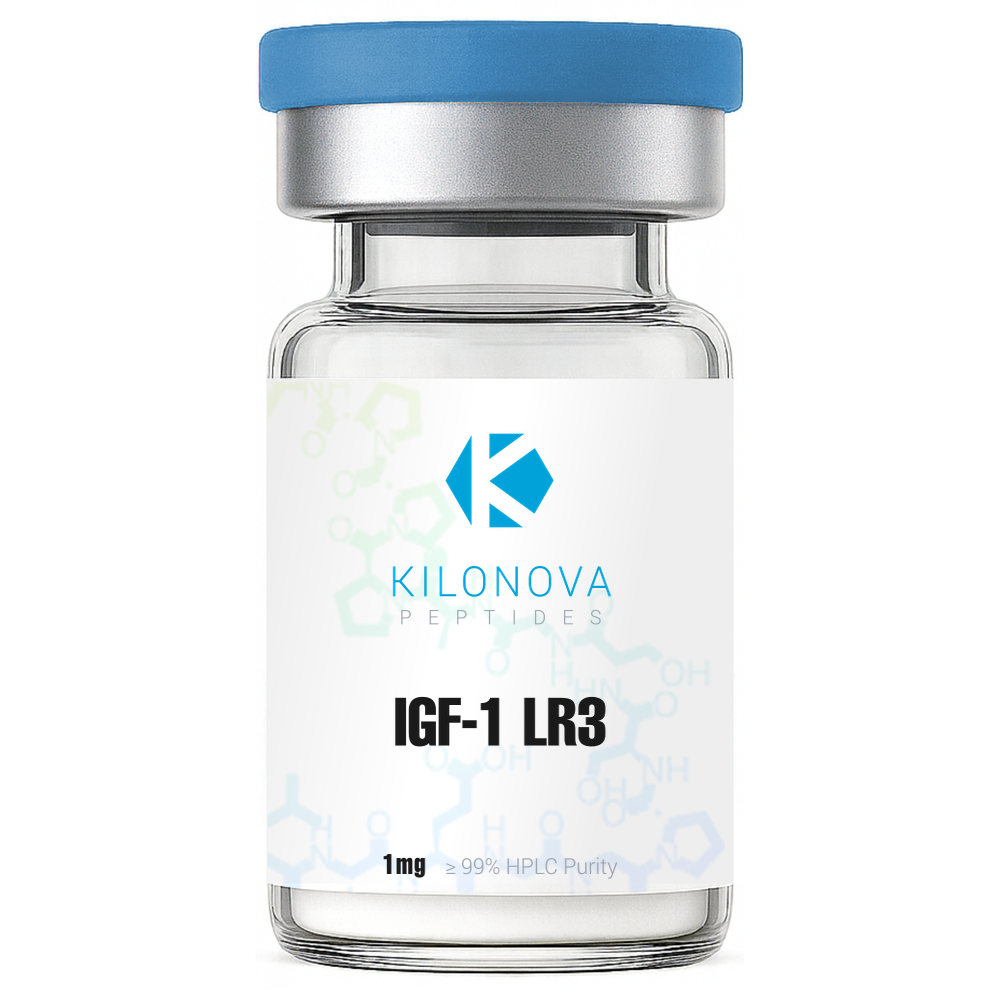
Long-R3 IGF-1 (also written IGF-1 LR3 or LR3-IGF-1) is a synthetic, 83-amino-acid analog of human insulin-like growth factor 1. Its sequence differs from native IGF-1 in two key respects: a glutamic-acid-to-arginine substitution at position 3, and an additional 13-amino-acid extension (MFPAMPLLSLFVN) appended to the N-terminus [5]. These deliberate modifications were engineered to alter the molecule's binding behavior and metabolic fate without eliminating its agonist activity at the IGF-1 receptor (IGF-1R) [5].
The structural changes have meaningful consequences for how the analog behaves in experimental systems. Native IGF-1 binds readily to insulin-like growth factor binding proteins (IGFBPs), which limit the pool of free, receptor-accessible ligand. Long-R3 IGF-1 exhibits markedly reduced affinity for IGFBPs, allowing a greater fraction of the molecule to engage IGF-1R directly [1][5]. Combined with an extended half-life estimated at roughly 20–30 hours — substantially longer than that of the native peptide — this profile makes the analog well suited for studying prolonged downstream signaling events in controlled experimental settings [5].
Researchers have applied Long-R3 IGF-1 across a range of preclinical and in vitro models. Investigations have examined its role in cell proliferation and differentiation cascades, including work in macrophage precursor systems where IGFBP accumulation was shown to modulate IGF-1 action differently depending on the analog used [1]. Additional studies have probed intracellular signaling branches such as the ERK and PI3K pathways in cardiomyocyte proliferation models [4], while others have explored protein metabolism responses in animal models [3]. The analog's recombinant production has itself been an area of methodological investigation, with groups developing expression systems to support both research supply and comparative bioactivity studies [2].
Kilonova Peptides supplies Long-R3 IGF-1 as a lyophilized peptide manufactured to high-purity specifications and tested for endotoxin content, supporting reproducibility in sensitive cellular and biochemical assay formats.
References
[1] Involvement of insulin-like growth factor-1 and its binding proteins in proliferation and differentiation of murine bone marrow-derived macrophage precursors. Endocrine, 1998. https://pubmed.ncbi.nlm.nih.gov/9867252/
[2] Recombinant expression of IGF-1 and LR3 IGF-1 fused with xylanase in Pichia pastoris. Applied Microbiology and Biotechnology, 2023. https://pubmed.ncbi.nlm.nih.gov/37261455/
[3] Action of long(R3)-insulin-like growth factor-1 on protein metabolism in beef heifers. Domestic Animal Endocrinology, 1999. https://pubmed.ncbi.nlm.nih.gov/10370861/
[4] Extracellular signal-regulated kinase and phosphoinositol-3 kinase mediate IGF-1 induced proliferation of fetal sheep cardiomyocytes. American Journal of Physiology. Regulatory, Integrative and Comparative Physiology, 2003. https://pubmed.ncbi.nlm.nih.gov/12947030/
[5] IGF-1 LR3. Wikipedia. https://en.wikipedia.org/wiki/IGF-1_LR3