Description
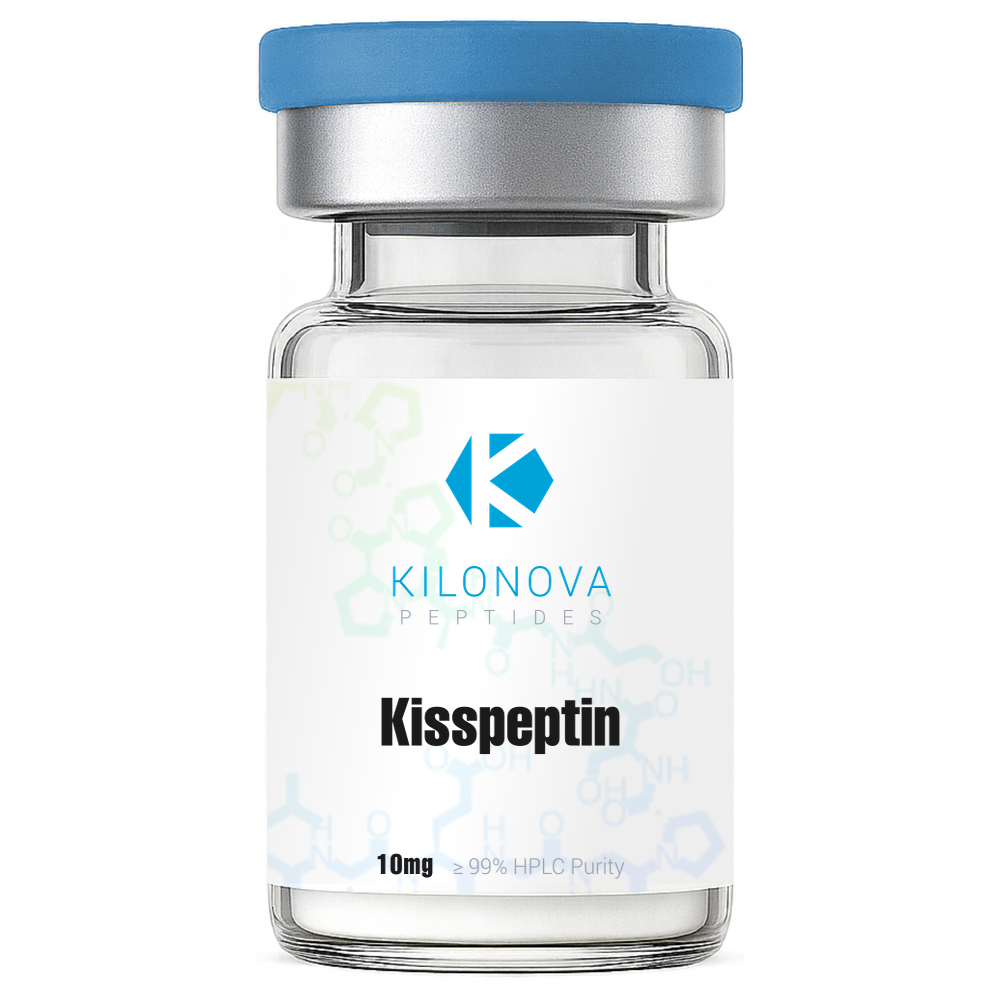
Kisspeptin-10 (KP-10) is a biologically active decapeptide derived from the C-terminal region of the larger precursor protein encoded by the KiSS-1 gene. With a molecular weight of approximately 1,302 Da [6], it belongs to the kisspeptin family of neuropeptides and serves as a natural, high-affinity ligand for GPR54 (also designated KISS1R), a G protein-coupled receptor [2]. Its compact ten-amino-acid sequence retains the full receptor-binding activity of the longer kisspeptin isoforms, making it a widely used research tool for probing ligand-receptor dynamics at the molecular level.
Structurally, KP-10 contains a tryptophan residue that has been noted to be susceptible to oxidative modification, specifically conversion to a kynurenine residue, a property that investigators working on peptide stability and analytical method development have found relevant to formulation and detection protocols [1]. The peptide's short sequence facilitates well-defined pharmacokinetic profiling in experimental systems, including rapid metabolic processing into identifiable fragment ions such as the y9, y8, y7, and y5 series [1], which has proven useful in mass spectrometry-based research workflows.
Research communities have employed KP-10 most extensively to interrogate the hypothalamic-pituitary-gonadal (HPG) axis. Studies have established GPR54 as an essential regulator of GnRH neuronal activation at puberty onset, with loss-of-function mutations in the receptor linked to hypogonadotrophic hypogonadism phenotypes in both human subjects and GPR54-null mouse models [2]. Beyond reproductive neuroendocrinology, investigators have applied KP-10 to examine osteoclast biology, where GPR54 activation has been shown to modulate Src kinase activity via Dusp18-mediated dephosphorylation, influencing bone resorption pathways in preclinical models [3].
Additional research has characterized KP-10 signaling in vascular cell biology, including its effects on endothelial cell proliferation, migration, and inflammatory gene expression, as well as its role in smooth muscle cell behavior and foam cell formation in atherosclerosis-related model systems [4]. The breadth of these experimental applications positions KP-10 as a versatile molecular probe for studying GPCR-mediated signaling across multiple physiological research domains.
References
[1] Investigating the detection of the novel doping-relevant peptide kisspeptin-10 in urine using liquid chromatography high-resolution mass spectrometry. Biomedical Chromatography : BMC, 2024. https://pubmed.ncbi.nlm.nih.gov/38978171/
[2] GPR54 and kisspeptin in reproduction. Human Reproduction Update, 2006. https://pubmed.ncbi.nlm.nih.gov/16731583/
[3] Kisspeptin-10 binding to Gpr54 in osteoclasts prevents bone loss by activating Dusp18-mediated dephosphorylation of Src. Nature Communications, 2024. https://pubmed.ncbi.nlm.nih.gov/38346942/
[4] Roles of the kisspeptin/GPR54 system in pathomechanisms of atherosclerosis. Nutrition, Metabolism, and Cardiovascular Diseases : NMCD, 2020. https://pubmed.ncbi.nlm.nih.gov/32409274/
[6] KISSPEPTIN-10 (ChEMBL CHEMBL376756). ChEMBL, European Bioinformatics Institute. https://www.ebi.ac.uk/chembl/compound_report_card/CHEMBL376756/